Introduction
Power has a way of feeling invisible until it disappears. Most people don’t think much about where their electricity comes from until a storm knocks out the grid for twelve hours, a camping trip takes them beyond the reach of any outlet, or an emergency situation makes reliable power the difference between comfort and genuine hardship. It’s in those moments — and increasingly, in the everyday reality of people who have chosen to live and work outside the boundaries of traditional grid dependence — that a portable power station stops being a luxury and starts being something considerably more essential.
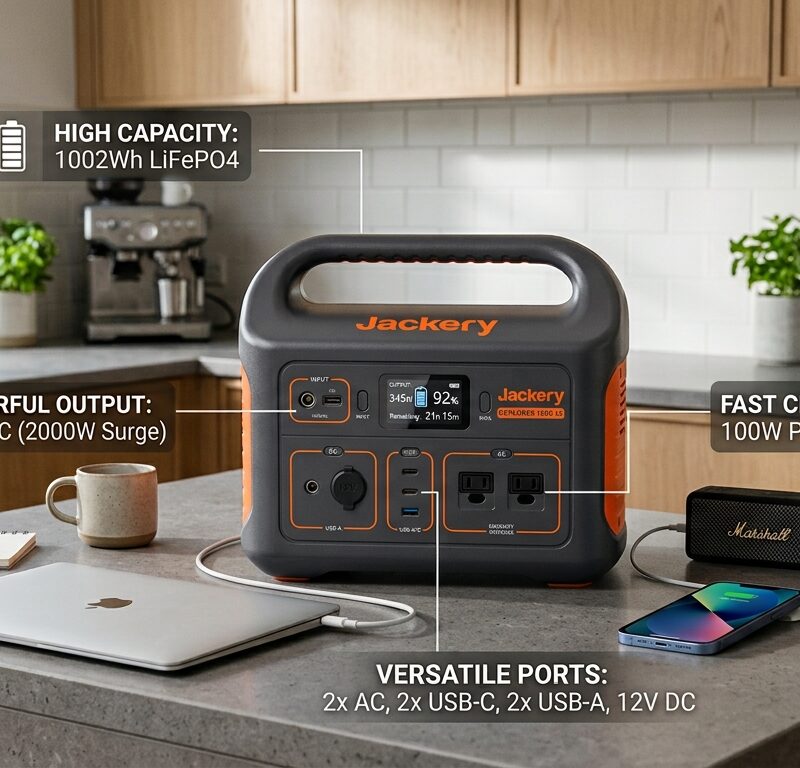
The Jackery Explorer 1000 v2 represents the brand’s current thinking on what a mid-to-large capacity portable power station should be in 2026. With a 1,070-watt-hour LiFePO4 battery, a 1,500-watt AC output capable of handling a wide range of real-world appliances, a 100-watt USB-C port, and a one-hour fast charging capability, it’s designed for people whose power needs go beyond charging a phone and extend into running actual equipment — whether that’s in a campsite, an RV, a home during a power outage, or a worksite without grid access.
This article takes a thorough, balanced look at what the Explorer 1000 v2 offers, how it functions across different use scenarios, who is most likely to find genuine value in it, and what’s worth understanding before making it part of your power infrastructure.
What Is the Jackery Explorer 1000 v2?
The Explorer 1000 v2 is a portable power station — essentially a large rechargeable battery with multiple output ports and a built-in inverter that converts stored DC power into AC electricity usable by standard household appliances and electronics. It’s manufactured by Jackery, a brand that has established a strong presence in the portable power category since the segment began growing substantially in the early 2020s.
The “v2” designation indicates this is the second generation of Jackery’s 1000-watt-hour Explorer line, and it brings meaningful upgrades over the original — most notably the switch to LiFePO4 (lithium iron phosphate) battery chemistry, which offers a longer cycle life and improved safety characteristics compared to the NMC lithium cells used in earlier models. The unit weighs in at a manageable size for its capacity class and includes a handle for portability, positioning it as something that can genuinely move between locations rather than sitting permanently in one spot.
Solar panel compatibility — sold separately — extends the unit’s usefulness by enabling renewable recharging in off-grid environments, making it a component in a broader solar generator setup rather than purely a battery that requires grid access to recharge.
Key Features of the Jackery Explorer 1000 v2
1,070Wh LiFePO4 Battery
The battery is the foundation of everything the Explorer 1000 v2 does, and the choice of LiFePO4 chemistry is one of the most significant upgrades in this generation. LiFePO4 batteries offer several meaningful advantages over the NMC lithium cells found in many competing units and in earlier Jackery models.
First, cycle life is substantially longer. LiFePO4 chemistry typically supports 3,000 or more charge cycles before capacity degrades to 80% — compared to 500 to 1,000 cycles for standard NMC lithium. This translates directly into years of additional useful life, which meaningfully changes the long-term value calculation of the unit.
Second, LiFePO4 batteries are inherently more thermally stable than NMC cells. They’re less prone to thermal runaway — the failure mode that, in extreme cases, causes lithium batteries to catch fire — which makes them a safer choice for use in enclosed spaces like RVs, tents, or indoor emergency situations.
Third, the chemistry performs more consistently across a wider temperature range, which matters for outdoor use where ambient conditions vary considerably.
The 1,070Wh capacity is a practical and meaningful amount of stored energy. To put it in concrete terms, it’s enough to run a small refrigerator for approximately 8 to 12 hours, charge a laptop 10 to 15 times, power a CPAP machine through multiple nights, or run a portable fan for an extended camping weekend — though exact run times depend heavily on the specific devices connected and their actual power consumption.
1,500W AC Output
The AC output specification is arguably the most practically important number after battery capacity, because it determines which real-world devices the power station can actually run. At 1,500 watts continuous output, the Explorer 1000 v2 can handle a meaningful range of appliances that lower-wattage units cannot.
Electric skillets, portable induction cooktops, small space heaters, power tools, full-size blenders, coffee makers, and similar appliances all fall within this range. A unit with only 600 or 800 watts of AC output would be unable to power many of these devices, limiting its practical usefulness in kitchen, workshop, or emergency heating contexts.
The 1,500-watt rating refers to continuous output — sustained power delivery over time. Startup or surge wattage, which some motors and compressors require for a brief moment when they initially power on, can exceed this figure, so checking the startup requirements of specific appliances before connecting them is always a sensible step.
100W USB-C Output
The 100-watt USB-C port is the fastest USB-C output available in consumer electronics, capable of rapidly charging laptops, tablets, and USB-C smartphones at their maximum charging speeds. For users who rely heavily on laptops — remote workers, content creators, digital nomads — having a 100-watt USB-C port means the power station can keep a laptop charged at the same speed or faster than a wall adapter, without needing to use one of the AC outlets.
One-Hour Fast Charging
The ability to recharge the unit from empty to full in approximately one hour via AC input is one of the standout practical features of the v2. Many portable power stations in this capacity class take four to six hours to fully recharge, which means planning around charging windows and accepting periods when the unit is tied to a wall outlet.
A one-hour recharge time fundamentally changes how the unit fits into a workflow. Between uses — between a camping day and an evening, or between a power outage event and the next day — the Explorer 1000 v2 can be fully restored to capacity in the time it takes to prepare and eat a meal. This is particularly valuable for users who need the unit available at consistent intervals rather than accepting a half-day recharge penalty.
Solar Panel Compatibility
While solar panels are sold separately, the Explorer 1000 v2 is designed to be used as part of a solar generator system. Compatible Jackery solar panels can be connected to the unit to provide renewable recharging capability, which is essential for truly off-grid use where grid access for recharging isn’t available.
The combination of the Explorer 1000 v2 and compatible solar panels creates a complete off-grid power system — energy is collected during daylight hours and stored in the battery for use anytime. For camping trips extending beyond a day or two, RV living, remote work setups, or any situation where sustained off-grid power is the goal rather than occasional supplemental power, the solar charging capability transforms the unit from a large battery into a renewable power infrastructure.
Multiple Output Ports
Beyond the AC outlets and 100W USB-C port, the Explorer 1000 v2 typically includes additional USB-A ports and a 12V DC car outlet, providing flexibility to power multiple devices simultaneously from different port types. This multi-device capability matters in real-world use, where a camping setup might simultaneously need to power a light, charge phones, and run a small appliance.
Portable Design with Carry Handle
Despite its substantial battery capacity, the Explorer 1000 v2 is designed to be moved between locations. A built-in carry handle and a weight that — while not light — is manageable for most adults over short distances makes it a genuinely portable unit rather than a fixed installation. For users who need to move it between a vehicle, a campsite, and a cabin, this portability matters.
How the Jackery Explorer 1000 v2 Can Be Used
Emergency Home Backup Power
Power outages — from storms, grid failures, or other disruptions — have become an increasingly common concern for many households. The Explorer 1000 v2’s capacity and AC output make it a capable emergency backup for essential appliances during a typical outage. Keeping a refrigerator running for several hours, powering medical equipment like CPAP machines, maintaining lighting, and keeping phones and devices charged are all within its capability.
Unlike a traditional gas generator, it operates silently, produces no fumes, and can be used safely indoors without ventilation concerns — three significant advantages in an indoor emergency power context.
Camping and Outdoor Recreation
For campers who want more than a basic power bank but less than a full RV electrical system, the Explorer 1000 v2 occupies a practical middle ground. It can power a portable cooler or fridge to keep food cold, run a camp light throughout the night, charge all the devices in a group, and power cooking appliances like an electric kettle or induction plate — covering most of the power needs of a well-equipped campsite.
Combined with compatible solar panels, it supports multi-day trips in remote locations where recharging from a vehicle or grid outlet isn’t available.
RV and Van Life
The Explorer 1000 v2 suits RV and van life applications where supplementing or replacing a built-in electrical system is the goal. For shorter trips or as a secondary power source, the unit handles the kind of everyday electrical needs — device charging, small appliance operation, lighting — that define life in a mobile living space.
Solar panel integration is particularly relevant here, as the combination of battery storage and solar collection creates a functional off-grid electrical system for RVs parked away from hookups.
Remote Work and Digital Nomad Power
For professionals working remotely in locations without reliable grid access — construction sites, rural properties, outdoor filming locations, field research environments — the Explorer 1000 v2 provides a dependable power source for laptops, cameras, drones, lighting equipment, and other professional tools. The 100W USB-C port ensures laptop charging happens at full speed, and the AC outlets accommodate equipment that requires standard wall power.
Off-Grid Living Support
For households pursuing varying degrees of off-grid living — whether a cabin without grid connection, a property in a rural area with unreliable power, or a homestead in development — the Explorer 1000 v2 combined with solar panels provides a foundational power system. While it won’t replace a whole-home electrical system, it supports essential devices and appliances with the reliability of stored solar energy.
Outdoor Events and Activities
For outdoor events, garden parties, film shoots, markets, or other activities that need power away from a building, the Explorer 1000 v2 provides a quiet, clean, portable power source that doesn’t require a generator and its associated noise, fumes, and fuel management.
Who the Jackery Explorer 1000 v2 May Be Suitable For
Households in Areas with Frequent Power Outages
For people who regularly experience grid outages due to weather, aging infrastructure, or geographic location, having a capable backup power source is a practical necessity rather than a luxury. The Explorer 1000 v2’s combination of capacity, AC output, and LiFePO4 longevity makes it a durable long-term investment for this use case.
Serious Campers and Outdoor Enthusiasts
Campers who want a fully equipped campsite experience — refrigeration, lighting, device charging, and cooking capability — without relying on campground electrical hookups will find the Explorer 1000 v2’s capacity and output well matched to those needs.
RV Owners and Van Lifers
People living or traveling in RVs, campervans, or converted vehicles benefit from the flexibility of a portable power station that supplements their existing system or stands alone as their primary power source on shorter trips.
Remote Workers in Field Environments
Professionals who regularly work in locations without reliable grid access — whether that’s a construction site, a remote filming location, or a rural property — benefit from a power source that keeps professional equipment running reliably throughout a workday.
People Building Off-Grid Power Systems
For those intentionally pursuing reduced grid dependence, whether for environmental reasons, energy independence, or remote living, the Explorer 1000 v2 paired with solar panels provides a building block for a functional off-grid power infrastructure.
Medical Equipment Users
People who rely on power-dependent medical devices — CPAP machines being the most common example — have a specific and non-negotiable need for reliable backup power during outages or when traveling in areas without grid access. The Explorer 1000 v2’s capacity is sufficient to run a CPAP machine through multiple nights, making it a meaningful safety net for this group.
Important Things to Consider
Weight and True Portability
Portable power stations at this capacity class are not lightweight. The Explorer 1000 v2’s weight — while manageable for moving between locations — means it’s not something most people carry for extended distances by hand. Understanding that portability in this context means movable between a car trunk, a campsite, and an indoor space rather than backpacking-level portability sets realistic expectations.
Appliance Wattage Verification
Before connecting any appliance, verifying its actual wattage requirement — both continuous and startup — against the Explorer 1000 v2’s output specifications is important. Appliances that exceed 1,500 watts continuous or have high startup surges may not run reliably from the unit. Checking appliance labels or manufacturer specifications beforehand avoids unexpected incompatibilities.
Solar Recharging Speed Depends on Panel Configuration
While the solar charging capability is a significant advantage, recharge time via solar depends entirely on panel wattage, sunlight availability, and environmental conditions. Overcast days, partial shading, and panel angle all affect how quickly solar input replenishes the battery. Setting realistic expectations around solar recharging speed — and having a grid recharging option available when needed — prevents frustration in practice.
It Is Not a Whole-Home Backup System
The Explorer 1000 v2 is a mid-size portable power station, not a whole-home backup generator. High-draw appliances like central air conditioning systems, electric stoves, electric dryers, and similar large home appliances are beyond its output capability. Understanding which specific devices and use cases the unit is intended to cover, and planning accordingly, is essential for realistic satisfaction with the product.
Regular Maintenance Charging
Like all battery-based systems, the Explorer 1000 v2 benefits from periodic charging even when not in active use, to maintain battery health over time. Storing the unit for extended periods at very low or very high charge states can affect long-term capacity, and following the manufacturer’s storage recommendations supports the battery’s longevity.
How the Jackery Explorer 1000 v2 Compares to Other Power Solutions
Traditional Gas Generators
Gas generators produce more power at lower upfront cost per watt than portable power stations, and they can run indefinitely as long as fuel is available. However, they produce exhaust fumes that make them unsafe for indoor use, require fuel storage and management, produce significant noise, and require maintenance including oil changes and carburetor care. The Explorer 1000 v2 operates silently, produces no fumes, requires no fuel, and demands essentially no maintenance — meaningful advantages for indoor emergency use and noise-sensitive environments like campgrounds.
Smaller Portable Power Stations (Under 500Wh)
Entry-level portable power stations in the 200 to 500Wh range are lighter, less expensive, and adequate for device charging and low-draw electronics. However, they cannot run the higher-wattage appliances — portable fridges, induction cooktops, power tools — that the Explorer 1000 v2 handles. For users whose needs extend beyond phones and laptops, the capacity and output gap between these categories is significant and practically meaningful.
Larger Capacity Power Stations (2000Wh+)
Units in the 2,000Wh and above category offer longer run times and often higher output wattage, suited to more demanding applications or longer off-grid periods. They are correspondingly heavier, larger, and more expensive. For users whose power needs are met by the Explorer 1000 v2’s capacity and output specifications, the added cost and bulk of larger units isn’t necessary. The 1,000Wh class represents a practical sweet spot for most camping, emergency backup, and moderate off-grid use cases.
Home Battery Storage Systems (Powerwall-style)
Fixed home battery storage systems like the Tesla Powerwall are permanently installed, house-scale solutions that integrate with home solar panels and the grid to provide seamless whole-home backup. They’re not portable, cost considerably more, and require professional installation. The Explorer 1000 v2 is a portable, no-installation solution that serves a different — and in many ways complementary — role in a household’s overall power resilience strategy.
Frequently Asked Questions
How long will the Explorer 1000 v2 power a typical refrigerator?
This depends heavily on the refrigerator’s power consumption. A small, efficient portable camping fridge drawing 40 to 60 watts can run for approximately 15 to 20 hours on a full charge. A standard household refrigerator drawing 150 watts or more would run for considerably fewer hours. Checking the specific appliance’s wattage and dividing it into the 1,070Wh capacity gives a rough estimate, accounting for inverter efficiency losses of approximately 10 to 15%.
Can the Explorer 1000 v2 be charged via solar and AC simultaneously?
This depends on the specific charging configuration supported by the unit. Checking the product documentation for simultaneous charging capability and any relevant limitations or cautions around combined input sources is recommended before attempting this approach.
How many charge cycles does the LiFePO4 battery support?
LiFePO4 chemistry typically supports 3,000 or more charge cycles before capacity drops to approximately 80% of original capacity, which represents a significant lifespan advantage over NMC lithium batteries used in many competing units. Actual cycle life depends on usage patterns and storage conditions.
Is it safe to use indoors during a power outage?
Yes. Unlike gas generators, the Explorer 1000 v2 produces no exhaust fumes and can be safely used indoors without ventilation concerns. It operates silently and generates only minimal heat during normal operation.
What solar panels are compatible with the Explorer 1000 v2?
Jackery’s own SolarSaga panel line is the primary compatible option, and various panel configurations are available at different wattage levels. Third-party panels with compatible connectors and within the unit’s solar input specifications may also work, though compatibility should be confirmed before purchase.
How heavy is the Explorer 1000 v2?
The unit’s weight falls in the range typical for 1,000Wh class portable power stations — manageable for moving between a vehicle and a campsite or indoor space, but not light enough for extended carrying on foot. Checking the current product listing for the specific weight figure is recommended.
Can it run a CPAP machine overnight?
Yes. Most CPAP machines draw between 30 and 60 watts during operation. At that consumption rate, the Explorer 1000 v2’s 1,070Wh capacity supports multiple nights of CPAP use on a single charge, making it a capable backup solution for CPAP users during power outages or off-grid travel.
Does it come with solar panels included?
No. Solar panels are sold separately. The Explorer 1000 v2 includes the power station unit itself along with charging cables for AC and car outlet recharging. Solar panels are available as separate purchases and are designated as optional in the product description.
Conclusion
The Jackery Explorer 1000 v2 represents a well-considered step forward in the mid-capacity portable power station category. The upgrade to LiFePO4 battery chemistry addresses the most significant long-term concern with earlier lithium-based units — cycle life and thermal stability — while the 1,500-watt AC output, 100-watt USB-C port, and one-hour fast charging combine to produce a unit that performs meaningfully in real-world applications rather than just on paper specifications.
Its value is clearest for households that want reliable emergency backup power, campers and outdoor enthusiasts who need more capability than a basic power bank provides, RV and van life users supplementing their mobile power systems, and anyone building toward greater energy independence through solar integration. The LiFePO4 chemistry’s extended cycle life makes it a longer-term investment than standard lithium units, which changes the cost-per-use calculation favorably over years of regular use.
It won’t replace a whole-home backup system for high-draw applications, and its weight means true backpacking portability isn’t the use case it’s built for. Within its intended scope — capable, quiet, clean, portable power for camping, emergency use, remote work, and off-grid living — the Explorer 1000 v2 delivers a thoughtfully engineered solution that earns its place in a serious portable power setup.